The Coordination–Consensus Continuum ↗
An observed conversation can be compatible with different underlying mechanisms. A causal framework for separating evidence of coordination from claims of consensus.
Explore the question →Question the story.
SIGNAL ↔ TRACE / CLICK THE WORD
I study the distance between what people do and what we claim it means. Then I build instruments to make that distance visible.
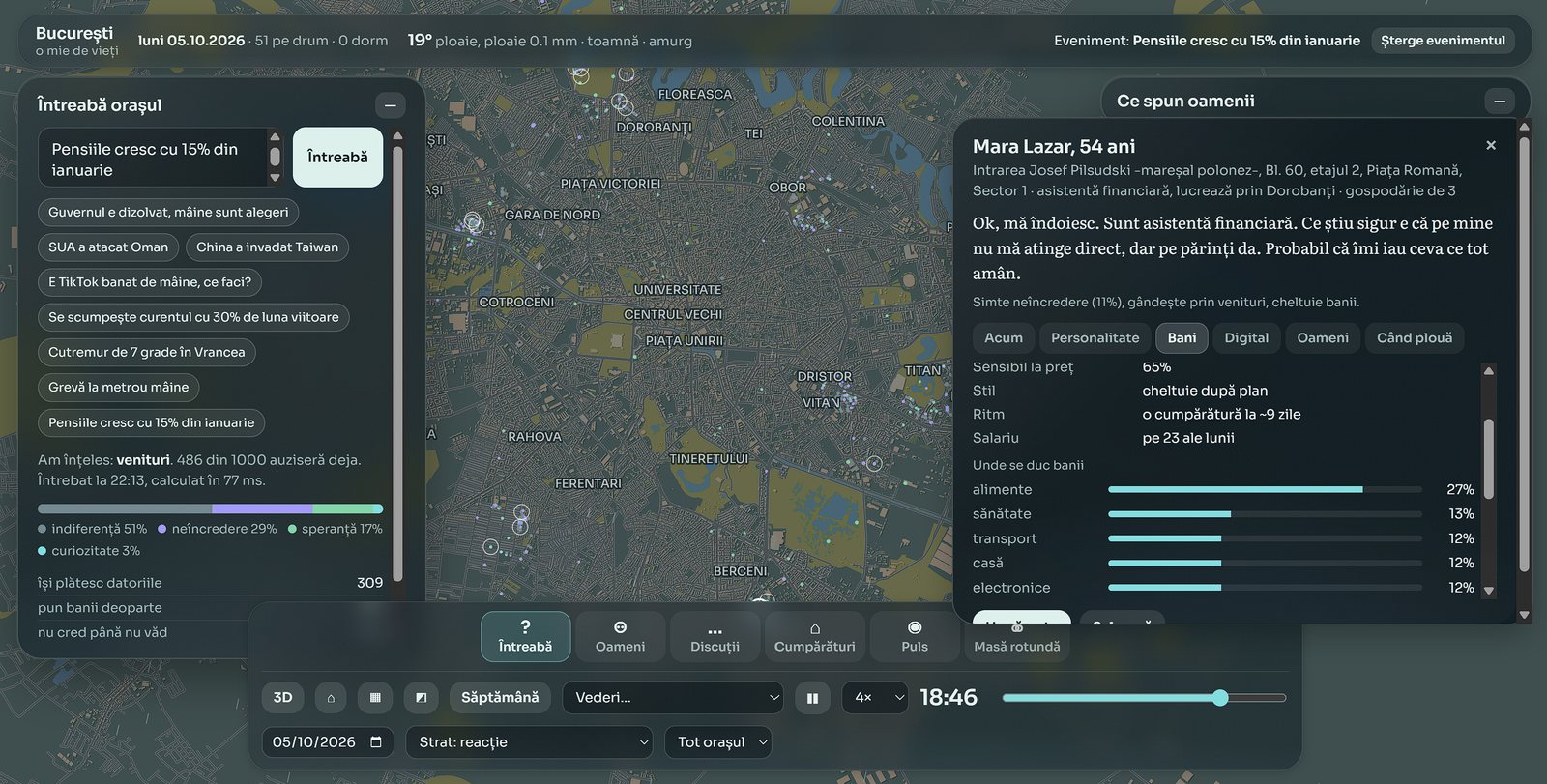
Explore the research ↘Use the instruments ↗BUCHAREST now runs on Vox6, a rebuilt deterministic engine. One thousand synthetic residents live a real day on a real map, and now inside an economy shaped like the real one: 111 brands across 19 industries, ads on their own channels and 29,724 brand conversations between people who know each other. Ask the city anything and every answer arrives with its reason. Run it twice and you get the same city, to the last byte.
 VOX6 · BETA
Echo Atlas is a live map of the planet: earthquakes, storms, fires, conflicts, space weather, internet outages, shipping chokepoints, launches and the news in every country, read from 18 public sources that need no account. Every event gets one deterministic importance score from 0 to 100, with the arithmetic shown next to it.
A bilingual research terminal: 91 signals and 14 collisions between them, verified on 11 October 2026. Consumer psychology, culture, nations, generations, industries, platform algorithms, papers and the news that moves behaviour. Every signal carries its counter-reading, a kit for strategists and a study design for researchers.
> brief
91 signals · 14 collisions · verified 11.10.2026
> psyche
[A] The same empathy is worth less once it is labelled AI
[A] Give GPT-4 your age and gender and it out-argues humans
> nations romania
[A] 55% of Romanians often see disinformation, against 35% across the EU
> collide 1
AI empathy wins as spectacle and loses as a gift
>
What does the evidence actually identify?
Follow the argument ↗II / INTELLIGENCEWhere does the public story part from the data?
Read the world ↗III / BUILDPut a better question in someone else’s hands.
Open the instruments ↗IV / WRITEStay with what refuses to become a number.
Enter the other room ↗Location appears only after your permission, with the accuracy reported by your device. Coordinates stay in this page and are not stored or sent to Alex.
Social and behavioral intelligence begins with a harder question: what else could have produced the same evidence?
An observed conversation can be compatible with different underlying mechanisms. A causal framework for separating evidence of coordination from claims of consensus.
Explore the question →A One-Sided Identification Frontier for Behavioral Evidence and Reflective Endorsement.
Explore the question →A vocal sample is not automatically the audience. Sharp bounds expose what the people who did not speak leave unresolved.
Explore the question →A click can be addressed to the brand, the platform or the feed itself. What do standard funnels lose when they cannot distinguish the recipient?
Explore the question →Lines show shared questions, not derivations. Select a theme to highlight its works; select a numbered point to open that paper in the catalogue.
The Coordination–Consensus Continuum separates an observed conversation from claims about the mechanisms behind it. The Silent Denominator asks what a vocal sample permits us to say about the wider audience.
Read the CCC · The Silent DenominatorThe Story Comes Cheap, its testing protocol and The Liar’s Dividend examine authenticity, signal cost and provenance from different angles.
Signal cost · Testing protocol · ProvenanceA distinctive trace need not establish individuality. A click need not be addressed to a brand. These papers challenge the interpretation we attach to observed behavior.
The Individuality Gap · Who Was the Click For?The Trace-Agency Gap brings behavioral evidence and reflective endorsement into the same research question.
Read The Trace-Agency GapListening pipelines can lose attribution evidence. Commercial decisions require their own assumptions about customer and stock states.
Listening pipelines · The Discount Comes LastWhy observational uniqueness does not establish person-specific structure. Nearly-full uniqueness in a database is compatible with zero real individuality — the percentage is not a weak signal, it is not a signal. Open the three in-browser demonstrations, in English or Romanian.
Explore the question →Brand authenticity as a cost inference, not a property consumers detect. If generative AI drives the cost of the carrying signal toward zero, which signals still separate an authentic sender from an inauthentic one? The paper derives that single condition — the signal floor — for identity goods.
Explore the question →The costed protocol for the signal-floor account: what an honest test would actually require, priced out, so the claim can be falsified rather than merely argued. Supplements The Story Comes Cheap.
Explore the question →Authentic work can carry a provenance penalty with no lie anywhere in the chain. Names the cost — the ambient provenance discount — the asset it depletes, and the only defence that survives: external corroboration, not what the image shows.
Explore the question →A euro withheld from someone who would have bought anyway is worth roughly ten of new revenue. An operator’s guide that routes promotions on customer and stock state together, and puts price reduction last behind four cheaper levers.
Explore the question →Follows one question — who is really speaking? — down the length of a listening pipeline. Collection, deduplication, classification, aggregation: each stage quietly discards some of the evidence that would separate coordinated amplification from genuine consensus, until a dashboard reports an agreement the raw trace never established.
Explore the question →The conceptual starting point for the Coordination–Consensus Continuum and the attribution problem in social listening.
Explore the question →Eleven ways into the conversation. Read its tensions, challenge its apparent consensus, and put your next move under pressure.
Hold the observed positive share at 68%. Change the share of the audience that participated.
Illustrative inputs. Binary attitude, a known participation share, and no assumptions about the silent group.
A population majority is not established.
Sentiment, emotion and momentum from public comments, read in seconds.
Open instrument →Echo 03The distance between how a brand speaks and how it is actually heard.
Open instrument →Echo 05What rose, what fell and what changed tone between two snapshots.
Open instrument →Echo 06The moment a conversation stops weighing a thing and starts moving on it.
Open instrument →Echo 09What the whole audience can believe, when only the vocal few spoke.
Open instrument →Echo 10Thousands who decided alone, or a few who staged it. The trace looks the same.
Open instrument →VectorWhich frame is winning, who carries it, and where it drifts.
Open instrument →Echo 02How well your language matches the language your market actually uses.
Open instrument →Echo 04Summary, insights, themes, tensions, risks and recommended actions.
Open instrument →Echo 07A campaign cross-examined before the market does it for you.
Open instrument →Echo 08Eight observable dimensions, extracted evidence, hooks and publishing assets.
Open instrument →Explore the research behind attribution and audience bounds →
Keep everything you can observe. Change the mechanism underneath.
Each person acts separately. Their actions produce the observed counts above.
The aggregate trace alone does not tell you which world produced it.
Read the Coordination–Consensus Continuum →A constructed example of observational equivalence, not an empirical finding. Additional evidence or assumptions may distinguish the mechanisms.
Data journalism at the fault line between what societies say and what their behavior leaves behind.
AI, trust, economy, work. Four ways to examine the distance between declared belief and revealed capacity.
Read the index ↗Three campaigns for Samsung Romania, each documented the same way: the tension people already live with, the position taken on it, and the result measured against a campaign that actually ran.
Young Romanians want local belonging and reject museum heritage. The campaign wrote down the folklore they were already living.
Six of six metrics beat target · 25K followers against a 7K benchmarkSAMSUNG TV · 2026Twenty years of market leadership, no product launch, the same budget. The anniversary moved from engineering to memory.
7.3M views against a 3M benchmark · engagement at twelve times priorCHRISTMAS · 2025One in two Romanians regifts. Instead of correcting the habit, the campaign built it a marketplace.
Engagement at twice the objective · 400 listings, no precedentEverything I teach here I tested on real budgets first, then built an instrument for, then measured. The campaigns above are where the thinking was proven; the courses are the same thinking, handed over in a form you can use on Monday.
And they are free. Knowledge should be: no payment, no account, no email address, nothing asked of you. Finish a course and you earn a certificate with your name on it, ready to add to LinkedIn.
Answer engines read a page differently from search engines, and most sites fail mechanically before the writing even matters. Thirteen sections, eight working instruments, a free audit of your own domain before you decide anything.
Free · certificate included ↗ADVANCED · AVAILABLEThe other half of the problem: not whether a machine can read you, but whether a person acts once they have. Twelve lessons, a copy-audit instrument, and a calibration test most people lose.
Free · certificate included ↗THE CATALOGUEFour are open now — free, with a certificate — and five are in preparation, across Essentials, Practice and Advanced. Each names who it is for and what you will be able to do afterwards — pick what you do and the catalogue reorders itself.
See everything ↗And the room learns to be quiet.
Dă dreapta la nouăzeci și patru la sută dintre profiluri.
Timp mediu de decizie: 0,4 secunde.
La tine a stat trei.
Nu înseamnă nimic.
Măsurăm oricum.A platform narrates the people it measures.
Fifty poems about distance, desire and the metrics of loneliness.
A love story witnessed from the windowsill. Each season has a voice. Each act, its own soundtrack.
Read & listen ↗VOLUME II / FORTY DAYSOne tower block. Forty days of mourning. A narrator climbs and reads the doors.
Enter the volume ↗
Researcher & Social and Behavioral Strategist.
Based in Bucharest, Romania.
I work where online language becomes behavioral evidence: audience intelligence, social listening, digital measurement and cultural strategy.
The Listening Room brings that practice together. The Coordination–Consensus Continuum asks what we can identify. Echo makes selected questions explorable. Data journalism follows their consequences into public life.
I build ways to see more clearly—and to know when the evidence runs out.
My experience on LinkedIn ↗ ResearchGate ↗