THE LISTENING ROOM · NEW ENGINE: VOX6 · BETA
BUCHAREST
a thousand lives
A behavioural digital twin of Bucharest. One thousand synthetic residents live a full day on a map of the real city, and when you type an event, each of them hears it, weighs it and answers in their own words.
NEW · THE ENGINE, REBUILT
Vox6: a deterministic engine for a whole city and its market.
BUCHAREST now runs on Vox6, a rebuilt, state-of-the-art deterministic engine. The same 1,000 residents now also live inside an economy shaped like the real one: they choose among 111 brands in 19 industries, from groceries and banks to telecom, energy, streaming and cars; they see ads on their own channels; they talk about brands with the people they know; and they change their minds for reasons you can read. No language model, and no randomness you cannot replay: run it twice and you get the same city, down to the last byte.
Agent simulations usually trade one thing for another. Language models give agents a voice but cannot be replayed exactly, and nobody can show why an agent said what it said. Classic models replay exactly but reduce people to a handful of averages. Vox6 keeps both: every resident is computed individually, every answer can be traced to its causes, and every run can be reproduced exactly.
Calibrated on the latest public figures where they exist (ANCOM 2025, ACAROM 2025, 2025 turnover and asset rankings), and every industry is labelled with how confident that calibration is.
Median gap between simulated and published market shares across the 19 industries. The validation tab shows where the model is close and where it is not.
Word of mouth between residents: who recommends which brand to whom, as a colleague, a friend or family, on which channel.
Where brands share customers the way marketing science predicts (the duplication-of-purchase pattern), checked inside the model's own validation.
Competition, ads, searches, the path to each brand, people and brands, and validation, side by side with the city.
A grocer triples its digital budget, a burger chain doubles TV, electricity rises by 30%, a bank faces a security scandal, and more, each with its effect on every brand.
Residents carry beliefs that colour how they react, and their lives change: pay rises, children, moving house.
A simulation: market figures do not describe the real performance of any company. Where no public figure exists, the calibration is marked as an estimate.
WHAT IT IS
A city you can ask a question.
BUCHAREST — A Thousand Lives is a behavioural digital twin of Bucharest built by Alex-George Adam. One thousand synthetic residents, each with a home on a real street, a job, a household budget, a personality and daily habits, live a full day on a map of the real city. Type any event (a price rise, a metro strike, an earthquake, an election) and every resident reacts individually: whether they hear about it and through which channel, how it touches their money and their family, what they feel, what they change in their day, and what they say.
It is my new pet project, and it is in beta. With elections on the horizon and the public conversation getting louder, I wanted something better than another dashboard: a way to rehearse how a city might react before it happens, and to see the reasons, person by person.
WHY 1,000 RESIDENTS
Big enough to read a city. Small enough to know everyone.
National opinion polls in Romania interview about 1,000–1,100 people. The CURS survey this engine is calibrated on had 1,100 respondents. A sample of 1,000 gives a margin of about ±3.1 points at 95% confidence for a 50/50 split, the same order of precision people already trust.
Each resident is simulated individually, not as an average. At 1,000, the whole city reacts to an event in well under a second on an ordinary laptop, with no server and no waiting.
You can follow anyone: their street, their route, their money, the people they talk to. At ten thousand, a person becomes a dot again. At a thousand, they stay a person.
Bucharest had about 1.7 million residents at the 2021 census. Each synthetic resident stands for roughly 1,700 real ones, which keeps the model honest about what it is: a panel, not a census.
EVERY RESIDENT IS DIFFERENT
Same event. A thousand reasons.
No two residents share a profile. Each one is generated with its own seed and carries:
SPATIAL GLASS DESIGN SYSTEM v1.0
The intelligence, made visible.
Most simulations hide their reasoning in a dashboard. This one puts it on the map, where you can see it happen.
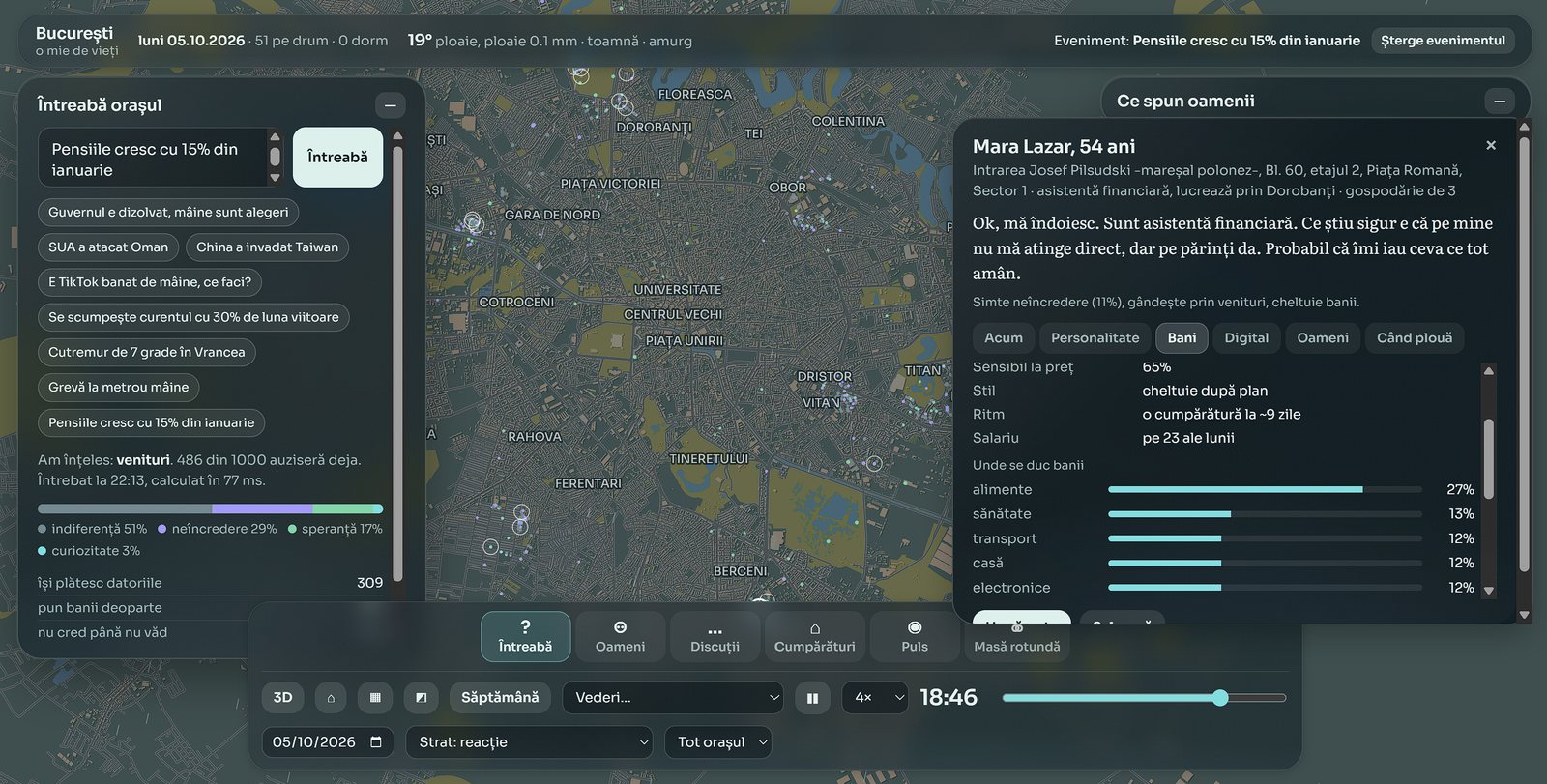
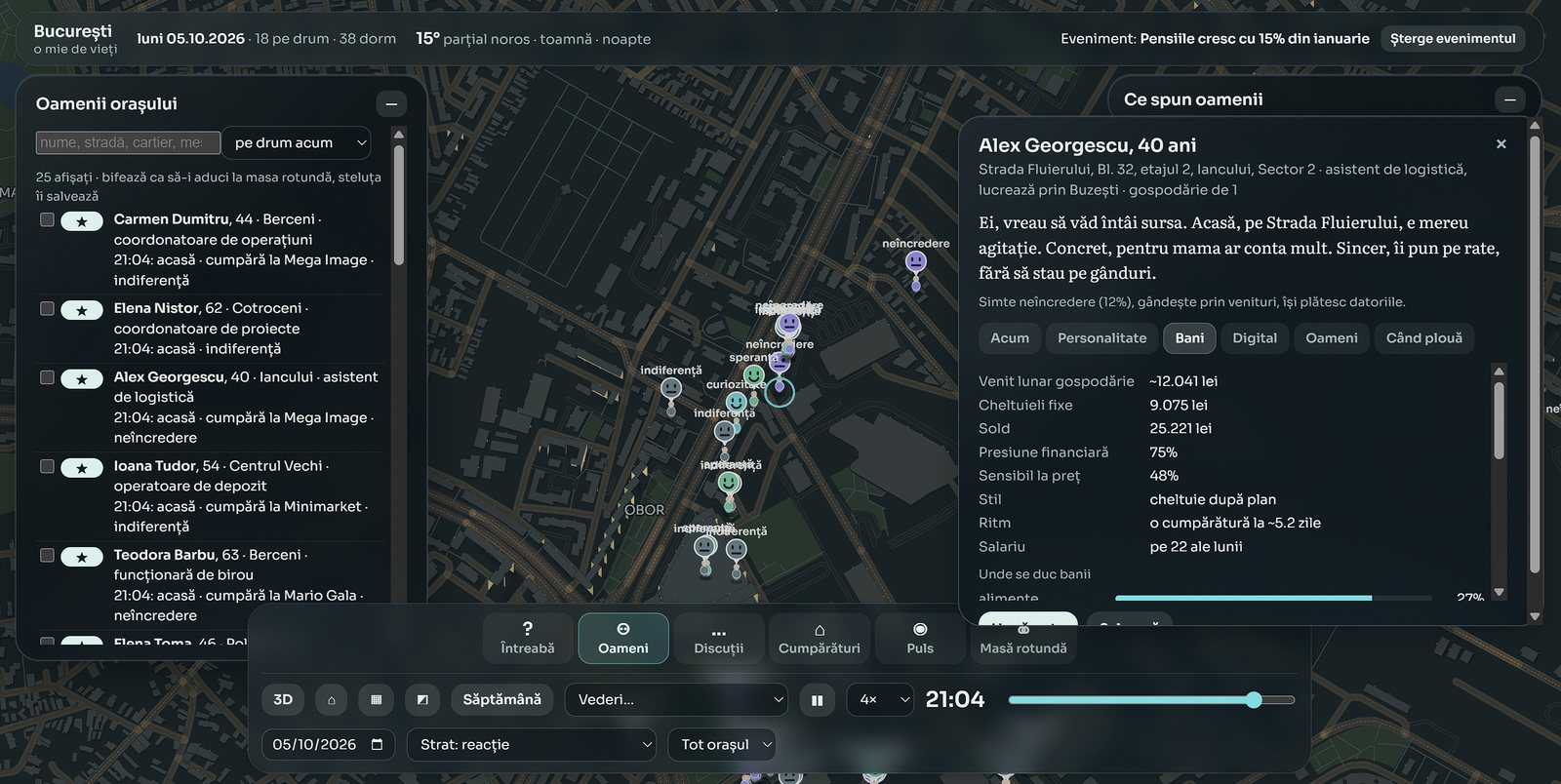
Living on the map in real time, with a mood bubble above each person once they have heard the news.
“Why they do what they do”: every trip in a resident's day has its reason, and every reaction shows the domain it touched, the traits that mattered, the action chosen and the alternative it beat.
Each resident's fixed core (household, money, personality, values, voice) that every answer has to stay consistent with.
Reactions change plans: leaving earlier, working from home, cancelling an outing, an extra trip to the shop for supplies or cash, each logged with the time and the reason.
News spreads in time: first to those already online, then by digital habit and appetite for news; sleepers learn when they wake up; then word of mouth through close contacts, in two waves.
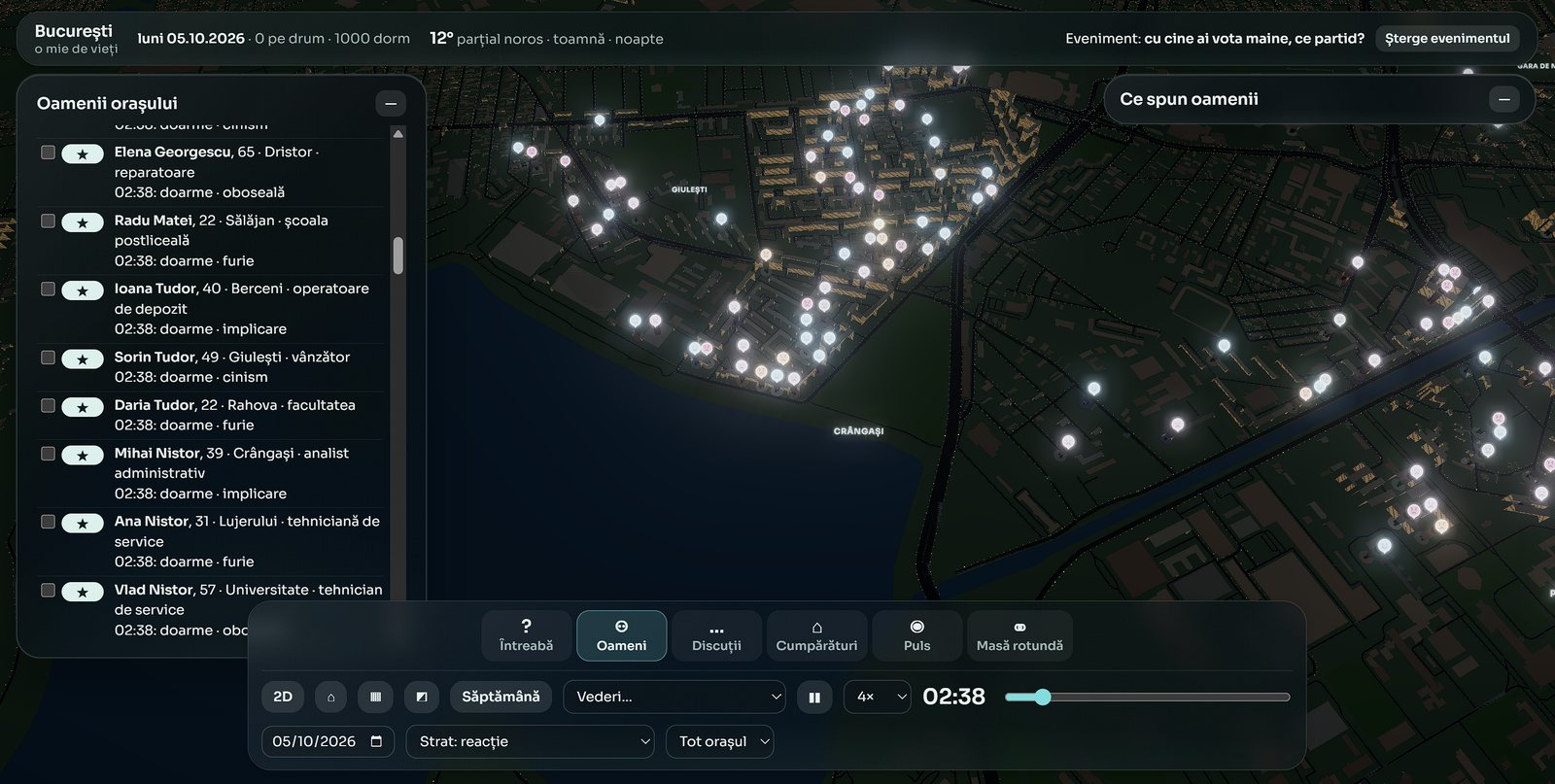
The whole city from OpenStreetMap in 2D and 3D, daylight from the real sunrise and sunset, hourly weather, weekends, seasons and snow.
UNDER THE HOOD
Deterministic, not generative.
The answers are not written by an AI chatbot. A purpose-built language engine (Vox5, inside the Vox6 engine) turns each resident's computed state into speech. For every event it decides, for each person: whether they learn about it and on which channel; the personal impact across domains such as prices, income, mobility, safety and politics; an emotion, using appraisal theory (relevance × control × resources); and an action, chosen by utility plus a small amount of randomness seeded per resident: unpredictable, but exactly reproducible.
Then it builds the sentence from the resident's own anchors (their street, their job, their money, their family), in their register and with their habits of speech. In the project's audits across ten events × 1,000 residents, all 1,000 answers were unique for every event, and two runs of the same event produce identical output, byte for byte.
PUBLIC DATA IN THE ENGINE
Built on the latest public data available to it.
- OpenStreetMap, via OpenMapTiles — the whole of Bucharest: 107,610 buildings with heights, 41,613 streets in five classes, 9,341 alleys and paths, 2,282 parks and bodies of water; real shops and parks used for residents' routes.
- CURS national poll, 16–22 September 2026 — 1,100 adults, face to face. Party affinities in the city are calibrated by iterative proportional fitting so the aggregate matches it (AUR 34%, PSD 25%, PNL 18%, USR 8%, others 15%), while each resident keeps their own issue-based structure.
- Market calibration — the latest public figures per industry: ANCOM 2025 for mobile and fixed internet, ACAROM 2025 for new-car registrations, 2025 turnover for the leaders in grocery, fashion, beauty, electronics and e-commerce, 2025 bank assets, JustWatch for streaming; marked as estimates where no public figure exists.
- A full 2026 calendar — working days and weekends, real sunrise and sunset for every date, and hourly weather for each day of the year.
- Established behavioural frameworks — the Big Five model of personality and appraisal theories of emotion, used as the structure of each resident's mind.
WHAT IT IS NOT
A rehearsal, not a prophecy.
- Not a poll and not a forecast. It shows how a plausible city could react and why. It does not measure what real Bucharesters think.
- Nobody here is real. Every resident is synthetic. Names, addresses and lives are generated; no personal data is used.
- The political calibration is national. No Bucharest-specific poll is in the data yet, so the city's aggregate follows the national CURS figures.
- The web version runs a typical day generated from schedules, places and habits; the full engine runs separately.
- It is a beta. There is a lot still to improve, especially the 3D visuals and the probabilistic side of the reactions.
BETA · WHAT COMES NEXT
A pet project, built in the open.
More detailed buildings and residents, smoother movement, camera bookmarks.
Reactions shown as probabilities with ranges, not as a single answer.
Regenerating every resident in the engine on addresses across all of Bucharest, and Bucharest-level calibration data.
QUESTIONS
Frequently asked.
What is BUCHAREST — A Thousand Lives?
A behavioural digital twin of Bucharest: 1,000 synthetic residents with homes, jobs, budgets, personalities and daily routines, living on a map built from OpenStreetMap. You type an event and each resident reacts individually, with a reason you can inspect.
What is new in the Vox6 engine?
A whole economy around the city: 111 brands in 19 industries, ads seen on each resident's own channels, 29,724 brand conversations between people who know each other, loyalty, beliefs and life events, plus a market observatory and eight market scenarios. Market shares are calibrated on public 2025 figures where they exist, with a median gap of about 1.3 points. Still deterministic and exactly reproducible.
Is it AI? Does it use ChatGPT or another language model?
No language model writes the answers. A deterministic engine computes each resident's reaction and builds the sentence from their own situation. Same input, same output, every time.
Why exactly 1,000 residents?
It matches the size of national opinion polls (about 1,000–1,100 people, around ±3 points of margin), it lets every resident be computed in full in your browser, and it keeps each one followable as a person. Each stands for about 1,700 real Bucharesters.
Which data does it use?
OpenStreetMap (via OpenMapTiles) for the city, the CURS national poll of 16–22 September 2026 for party affinities, a 2026 calendar with daylight and hourly weather, and the Big Five and appraisal-theory frameworks for how residents think.
Can it predict the election?
No. It is not a poll and not a forecast. It shows how a plausible city might react to an event and why, which is useful for testing messages and decisions, not for predicting results.
Does it collect my data?
No. Everything runs in your browser. Questions you type are processed on your device and are not sent anywhere.
Is it free?
Yes. Like everything in The Listening Room, it is free and needs no account.
THE LISTENING ROOM · MOTOR NOU: VOX6 · BETA
BUCUREȘTI
o mie de vieți
Un geamăn digital comportamental al Bucureștiului. O mie de rezidenți sintetici trăiesc o zi întreagă pe harta orașului real, iar când scrii un eveniment, fiecare îl află, îl cântărește și răspunde cu vorbele lui.
NOU · MOTORUL, RECONSTRUIT
Vox6: un motor determinist pentru un oraș întreg și piața lui.
BUCHAREST rulează acum pe Vox6, un motor determinist reconstruit, de ultimă generație. Aceiași 1.000 de rezidenți trăiesc acum și într-o economie cu forma celei reale: aleg între 111 branduri din 19 industrii, de la retail alimentar și bănci la telecom, energie, streaming și mașini; văd reclame pe canalele lor; vorbesc despre branduri cu oamenii pe care îi cunosc; și își schimbă părerea din motive pe care le poți citi. Niciun model de limbaj și nicio întâmplare pe care să n-o poți repeta: rulezi de două ori și obții același oraș, până la ultimul octet.
Simulările cu agenți renunță de obicei la ceva. Modelele de limbaj le dau agenților o voce, dar nu pot fi repetate exact și nimeni nu poate arăta de ce un agent a spus ce a spus. Modelele clasice se repetă exact, dar reduc oamenii la câteva medii. Vox6 le păstrează pe amândouă: fiecare rezident e calculat separat, fiecare răspuns poate fi urmărit până la cauzele lui și fiecare rulare poate fi reprodusă exact.
Calibrate pe cele mai noi cifre publice acolo unde există (ANCOM 2025, ACAROM 2025, clasamente de cifră de afaceri și active pe 2025), iar fiecare industrie e marcată cu cât de sigură e calibrarea.
Diferența mediană dintre cotele de piață simulate și cele publicate, pe cele 19 industrii. Fila de validare arată unde modelul e aproape și unde nu.
Recomandările dintre rezidenți: cine ce brand recomandă cui, ca coleg, prieten sau rudă, pe ce canal.
În care brandurile își împart clienții cum prezice știința marketingului (tiparul de duplicare a cumpărării), verificat în validarea proprie a modelului.
Concurență, reclame, căutări, drumul spre fiecare brand, oameni și branduri, validare, alături de oraș.
Un retailer își triplează bugetul digital, un lanț de fast food dublează TV-ul, curentul se scumpește cu 30%, o bancă are un scandal de securitate și altele, fiecare cu efectul lui asupra fiecărui brand.
Rezidenții au convingeri care le colorează reacțiile, iar viețile lor se schimbă: măriri de salariu, copii, mutări.
E o simulare: cifrele de piață nu descriu performanța reală a niciunei companii. Unde nu există o cifră publică, calibrarea e marcată ca estimare.
CE ESTE
Un oraș căruia îi poți pune o întrebare.
BUCHAREST — o mie de vieți e un geamăn digital comportamental al Bucureștiului, construit de Alex-George Adam. O mie de rezidenți sintetici, fiecare cu o casă pe o stradă reală, o meserie, un buget al gospodăriei, o personalitate și obiceiuri zilnice, trăiesc o zi întreagă pe harta orașului real. Scrii orice eveniment (o scumpire, o grevă la metrou, un cutremur, alegeri) și fiecare rezident reacționează separat: dacă află și pe ce canal, cum îi atinge banii și familia, ce simte, ce schimbă în ziua lui și ce spune.
E noul meu proiect de suflet și e în beta. Cu alegerile la orizont și discuția publică tot mai zgomotoasă, am vrut ceva mai bun decât încă un dashboard: un fel de a repeta cum ar putea reacționa un oraș înainte să se întâmple, cu motivele la vedere, om cu om.
DE CE 1.000 DE REZIDENȚI
Destul de mulți ca să citești un oraș. Destul de puțini ca să-i cunoști pe toți.
Sondajele naționale din România intervievează în jur de 1.000–1.100 de oameni. Sondajul CURS pe care e calibrat motorul a avut 1.100 de respondenți. Un eșantion de 1.000 dă o marjă de aproximativ ±3,1 puncte la un nivel de încredere de 95% pentru o împărțire 50/50, aceeași precizie în care oamenii au deja încredere.
Fiecare rezident e simulat individual, nu ca medie. La 1.000, tot orașul reacționează la un eveniment în mult sub o secundă pe un laptop obișnuit, fără server și fără așteptare.
Poți urmări pe oricine: strada, drumul, banii, oamenii cu care vorbește. La zece mii, un om redevine un punct. La o mie, rămâne om.
Bucureștiul avea aproximativ 1,7 milioane de locuitori la recensământul din 2021. Fiecare rezident sintetic ține locul a circa 1.700 de bucureșteni reali, ceea ce ține modelul cinstit despre ce este: un panel, nu un recensământ.
FIECARE REZIDENT E ALTFEL
Același eveniment. O mie de motive.
Nu există doi rezidenți cu același profil. Fiecare e generat cu propria sămânță și are:
SPATIAL GLASS DESIGN SYSTEM v1.0
Inteligența simulării, la vedere.
Majoritatea simulărilor își ascund raționamentul într-un dashboard. Aceasta îl pune pe hartă, unde îl vezi cum se întâmplă.
Trăiesc pe hartă în timp real, cu o bulă de stare deasupra fiecăruia după ce a aflat vestea.
„De ce face ce face”: fiecare drum din ziua unui rezident are motivul lui, iar fiecare reacție arată domeniul atins, trăsăturile care au contat, acțiunea aleasă și alternativa pe care a învins-o.
Nucleul fix al fiecărui rezident (gospodăria, banii, personalitatea, valorile, vocea), cu care orice răspuns trebuie să rămână consecvent.
Reacțiile schimbă planuri: pleacă mai devreme, lucrează de acasă, renunță la o ieșire, un drum în plus la magazin pentru provizii sau numerar, fiecare notat cu ora și motivul.
Vestea se răspândește în timp: întâi la cei deja online, apoi după obiceiurile digitale și apetitul pentru știri; cei care dorm află când se trezesc; apoi din gură în gură prin contactele apropiate, în două valuri.
Tot orașul din OpenStreetMap în 2D și 3D, lumina după răsăritul și apusul reale, vremea pe ore, weekenduri, anotimpuri și zăpadă.
CUM FUNCȚIONEAZĂ
Determinist, nu generativ.
Răspunsurile nu le scrie un chatbot. Un motor de limbaj construit special (Vox5, în interiorul motorului Vox6) transformă starea calculată a fiecărui rezident în vorbire. Pentru fiecare eveniment decide, pentru fiecare om: dacă află și pe ce canal; impactul personal pe domenii precum prețuri, venituri, mobilitate, siguranță și politică; o emoție, după teoria evaluării (relevanță × control × resurse); și o acțiune, aleasă după utilitate plus o doză mică de întâmplare cu sămânță proprie fiecărui rezident: imprevizibilă, dar reproductibilă exact.
Apoi construiește fraza din reperele lui (strada, meseria, banii, familia), în registrul lui și cu felul lui de a vorbi. În auditurile proiectului, pe zece evenimente × 1.000 de rezidenți, toate cele 1.000 de răspunsuri au fost unice la fiecare eveniment, iar două rulări ale aceluiași eveniment dau rezultate identice, octet cu octet.
DATE PUBLICE ÎN MOTOR
Construit pe cele mai noi date publice pe care le are.
- OpenStreetMap, prin OpenMapTiles: tot Bucureștiul, cu 107.610 clădiri cu înălțimi, 41.613 străzi pe cinci clase, 9.341 de alei și 2.282 de parcuri și ape; magazinele și parcurile reale sunt folosite în drumurile rezidenților.
- Sondajul național CURS, 16–22 septembrie 2026: 1.100 de adulți, față în față. Afinitățile de partid din oraș sunt calibrate prin ajustare proporțională iterativă ca agregatul să corespundă (AUR 34%, PSD 25%, PNL 18%, USR 8%, alții 15%), iar fiecare rezident își păstrează structura proprie, pe teme.
- Calibrarea pieței: cele mai noi cifre publice pe industrie: ANCOM 2025 pentru telefonie mobilă și internet fix, ACAROM 2025 pentru înmatriculări de mașini noi, cifre de afaceri 2025 pentru liderii din retail alimentar, fashion, beauty, electronice și e-commerce, active bancare 2025, JustWatch pentru streaming; marcate ca estimări unde nu există o cifră publică.
- Un calendar complet pe 2026: zile lucrătoare și weekenduri, răsăritul și apusul reale pentru fiecare dată și vremea pe ore pentru fiecare zi a anului.
- Modele comportamentale consacrate: modelul Big Five al personalității și teoriile evaluării emoționale, folosite ca structură a minții fiecărui rezident.
CE NU ESTE
O repetiție, nu o profeție.
- Nu e un sondaj și nu e o prognoză. Arată cum ar putea reacționa un oraș plauzibil și de ce. Nu măsoară ce cred bucureștenii reali.
- Nimeni de aici nu e real. Toți rezidenții sunt sintetici. Numele, adresele și viețile sunt generate; nu se folosesc date personale.
- Calibrarea politică e națională. În date nu există încă un sondaj pe București, așa că agregatul orașului urmează cifrele naționale CURS.
- Versiunea web rulează o zi tipică, generată din programe, locuri și obiceiuri; motorul complet rulează separat.
- E un beta. Mai e mult de îmbunătățit, mai ales partea vizuală 3D și latura probabilistică a reacțiilor.
BETA · CE URMEAZĂ
Un proiect de suflet, construit la vedere.
Clădiri și oameni mai detaliați, mișcare mai fluidă, vederi salvate ale camerei.
Reacții arătate ca probabilități, cu intervale, nu ca un singur răspuns.
Regenerarea fiecărui rezident în motor pe adrese din tot Bucureștiul și date de calibrare la nivelul orașului.
ÎNTREBĂRI
Întrebări frecvente.
Ce este BUCHAREST — o mie de vieți?
Un geamăn digital comportamental al Bucureștiului: 1.000 de rezidenți sintetici cu case, meserii, bugete, personalități și rutine, care trăiesc pe o hartă construită din OpenStreetMap. Scrii un eveniment și fiecare reacționează separat, cu un motiv pe care îl poți verifica.
E inteligență artificială? Folosește ChatGPT sau alt model de limbaj?
Niciun model de limbaj nu scrie răspunsurile. Un motor determinist calculează reacția fiecărui rezident și construiește fraza din situația lui. Aceeași intrare, același rezultat, de fiecare dată.
De ce exact 1.000 de rezidenți?
Corespunde mărimii sondajelor naționale (în jur de 1.000–1.100 de oameni, cu o marjă de aproximativ ±3 puncte), permite ca fiecare rezident să fie calculat complet în browser și îl păstrează pe fiecare ușor de urmărit ca om. Fiecare ține locul a circa 1.700 de bucureșteni reali.
Ce date folosește?
OpenStreetMap (prin OpenMapTiles) pentru oraș, sondajul național CURS din 16–22 septembrie 2026 pentru afinitățile de partid, un calendar pe 2026 cu lumina zilei și vremea pe ore, plus modelele Big Five și teoria evaluării pentru felul în care gândesc rezidenții.
Poate prezice alegerile?
Nu. Nu e un sondaj și nici o prognoză. Arată cum ar putea reacționa un oraș plauzibil la un eveniment și de ce, ceea ce ajută la testarea mesajelor și a deciziilor, nu la prezicerea rezultatelor.
Îmi colectează datele?
Nu. Totul rulează în browser. Întrebările pe care le scrii sunt procesate pe dispozitivul tău și nu sunt trimise nicăieri.
E gratuit?
Da. Ca tot ce e în The Listening Room, e gratuit și nu cere cont.